Sheet 01
The cohort problem
St. Charles County
Why a whole street needs a roof at once
If three of your neighbours have had roofers in this year, that is not a coincidence and it is not a sales line. It is arithmetic.
Housing in St. Charles County arrived in blocks. A developer platted a subdivision, a builder framed it out over one or two seasons, and every roof on it went on within a short window of every other roof on it, usually with the same shingle from the same supplier because that is how material gets bought. Streets in this county are therefore cohorts in the statistical sense: a set of things that started at the same time and are ageing under the same conditions.
Compare that with the older parts of the metro across the river, where a street can hold a house from the 1920s next to one from 1958 next to an infill from 2004. Those roofs came due at different times, so the street never has a moment. A St. Charles County subdivision has a moment, and everybody living on it goes through it together.

Plate 1
A street built as one thing. The houses share a builder, a season, a supplier and a shingle, and the small trees in the lawns are all the same age because they went in with the houses. Twenty five years on, a street like this does not arrive at the end of its roof life one address at a time. Generated illustration of the county's subdivision stock. It is not a photograph and not a Keys jobsite.Diagram: a street reaching the end of its clock
- Past service life
- Inside five years of it
- Still in the middle of it
A diagram of the argument. No real street was surveyed to draw it, and the split shown is illustrative.
How to read the age of your own street
You do not need to get on the roof, and you should not. Four readings from the ground and one from inside will tell you most of what you need.
- Count the skips. A roll off skip in a driveway with shingle debris in it is the most reliable signal there is. Two or three on one street in a season means the cohort has started to turn over.
- Look at colour, not condition. Stand at one end of the street and look down the line of roofs. Fresh roofs read darker and more even. If your roof is visibly lighter and blotchier than the new ones, that is granule loss, and granule loss is the shingle spending its remaining life.
- Look at the ridge line. A ridge that has gone wavy, or cap shingles that are lifting at their corners, is telling you the field below is stiff and brittle.
- Look in the gutter. A handful of granules after a storm is normal on a new roof and is normal to see for the first year or two. A gutter with a consistent silt of granules in it years later is a roof shedding its surface.
- Look in the attic on a bright day. Daylight through the deck, dark staining on the underside of the sheathing, or a damp smell after rain are all worth a call, and none of them require anybody on your roof to see.
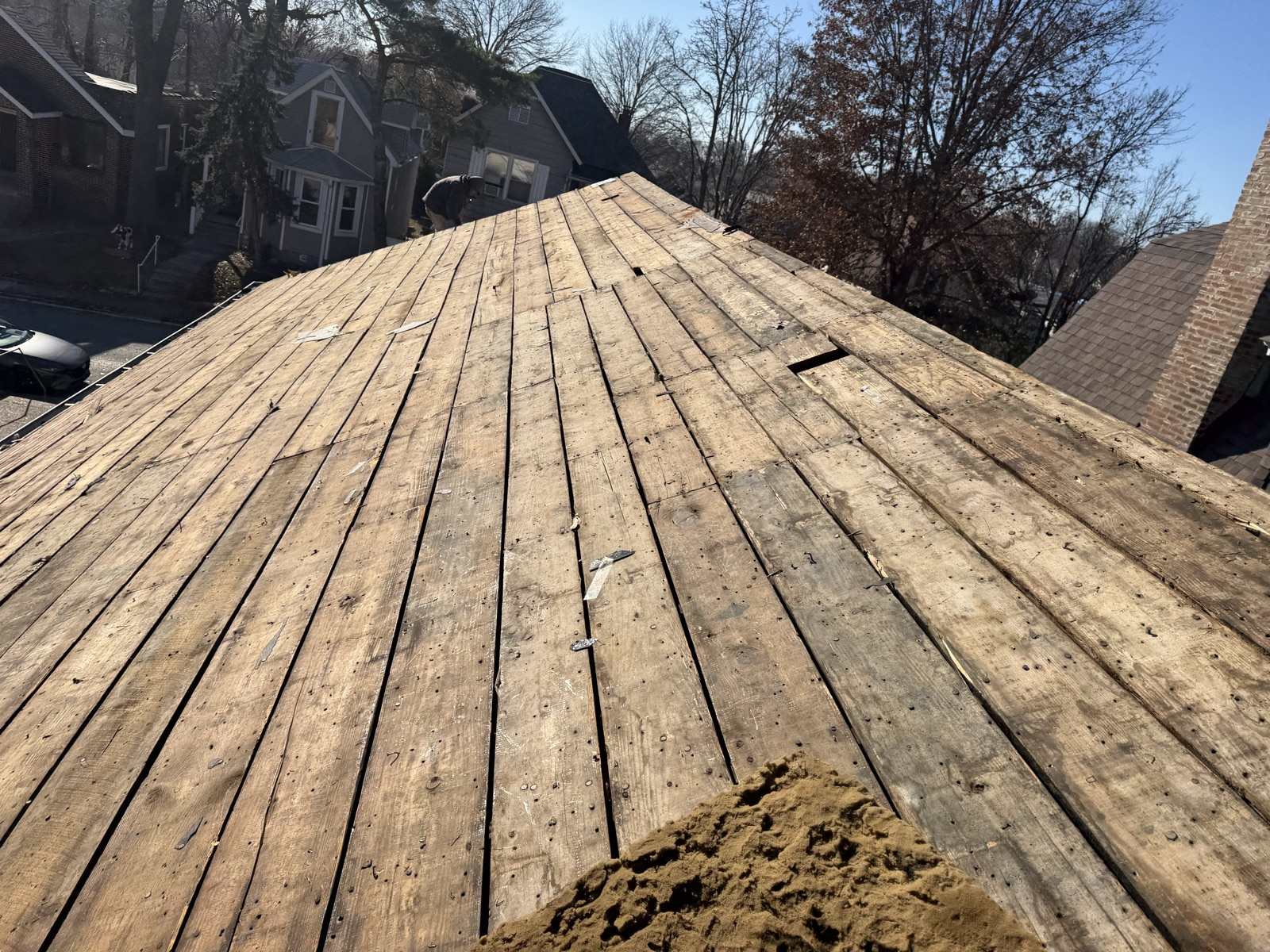
Plate 2
A Keys job in the greater St. Louis area. This roof has been stripped to its original wide plank decking, boards weathered grey and still studded with old nail heads, with scraps of felt caught in the gaps between them. The pile of loose granules at the bottom right is what came off the old shingle. Beyond the ridge, at ground level beside the neighbouring grey house, a figure is bent over. The houses beyond are older stock than most of this county, which is exactly why the decking here is plank rather than panel.What the cohort does to the market
A street of forty roofs all reaching the same point is a route, and routes are worth travelling for. That is the honest explanation for why door knocking is heavier here than in most of the metro, and it is why the crews doing it are often not from here. There is a sheet on how to handle that conversation.
It also means that when a hailstorm crosses a subdivision, the damage assessment is not one house at a time. Whole blocks get inspected in a fortnight. Some of those inspections are careful and some of them are a man on a ladder with a camera phone who has forty more to do before dark, and you cannot tell which you are getting from the truck.
The one thing worth doing early
Get the roof documented before you need it documented. A dated set of photographs, a measured drawing and a written scope cost you nothing to hold and mean that when a storm does cross your street you already know what was up there and what condition it was in. That is a contractor's job and it is entirely within what a contractor may do, unlike anything to do with negotiating a claim, which Missouri law does not permit a roofer to do on your behalf.
If your street is turning over, say so when you call. It changes the order things get looked at in.
Next sheet
The St. Charles County roofing registerAll 81 registered firms, in weighted order, with the method shown.