Sheet 00
St. Charles County, Missouri
Opened 2026
St. Charles County Roofing
Roofs fail by the street here, not by the house. That is a fact about how this county was built, and it should change what you do when somebody knocks.
St. Louis County went up house by house across a century, so its roofs come due one at a time and nobody notices. St. Charles County was platted. Whole streets were laid out in a single season, framed by one builder, and shingled the same week off the same truck. Twenty five years later those streets come due together, which is why a crew that knocks on one door in a subdivision here can reasonably knock on forty, and why the same week that brings a legitimate roofer to your street brings six other trucks behind him.
This site is the file we keep on that. It is advertising, and it is written by people who want the work, so read it the way you would read anything with a commercial interest behind it. What is on it is checkable: a county register built from a dated Google Maps pull, the NOAA hail record for this county, the Missouri statutes that actually exist, and photographs of real Keys jobs with captions that describe what is in the frame rather than what would sell better.
- 54NOAA logged hail events in this county, 2020 to 2025
- 1.48 inAverage logged stone, larger than St. Louis County's 1.32 in
- 81Roofing contractors registered inside the county on a Maps pull dated 2026-08-23
Hail: NOAA Storm Events, county totals 2020 to 2025. Firms: Google Maps pull, 2026-08-23, rows whose category is exactly Roofing contractor.
01
The cohort problem
Why this county is different
A subdivision is a cohort, and cohorts fail together
An asphalt shingle does not have an expiry date, it has a service life, and the things that spend that life are ultraviolet light, thermal cycling, wind uplift at the edges and hail. Two identical roofs a mile apart in this county have had almost identical weather. If they went on in the same year, they are in the same condition now, give or take how much afternoon sun each one takes and how many trees are over it.
That is unremarkable on its own. What makes it matter here is that St. Charles County did not add its housing gradually. It added it in blocks, subdivision by subdivision, and the roofs went on in blocks too. So when one house on a street of forty needs a roof, it is not a coincidence that the neighbour two doors down is getting quotes in the same month. They are the same age. They have taken the same hail. They are simply arriving at the end of the same clock.
Diagram: one platted street, 24 lots
- Past service life
- Inside five years of it
- Still in the middle of it
This is a diagram of the argument, not a survey of a real street. No street in this county was measured to draw it.
What that means for you, practically
- Your neighbours are your best data. If three houses on your street have been reroofed in eighteen months, yours is not far off, whatever it looks like from the ground.
- Volume arrives before quality does. A street of forty roofs all coming due is a route, and routes attract crews who are here for the route and not for the county.
- The cheapest quote on the street is usually cheapest for a reason that is written down. Ventilation, decking replacement, drip edge and starter course are the four line items that vary most between two proposals on the same house. There is a sheet on that.
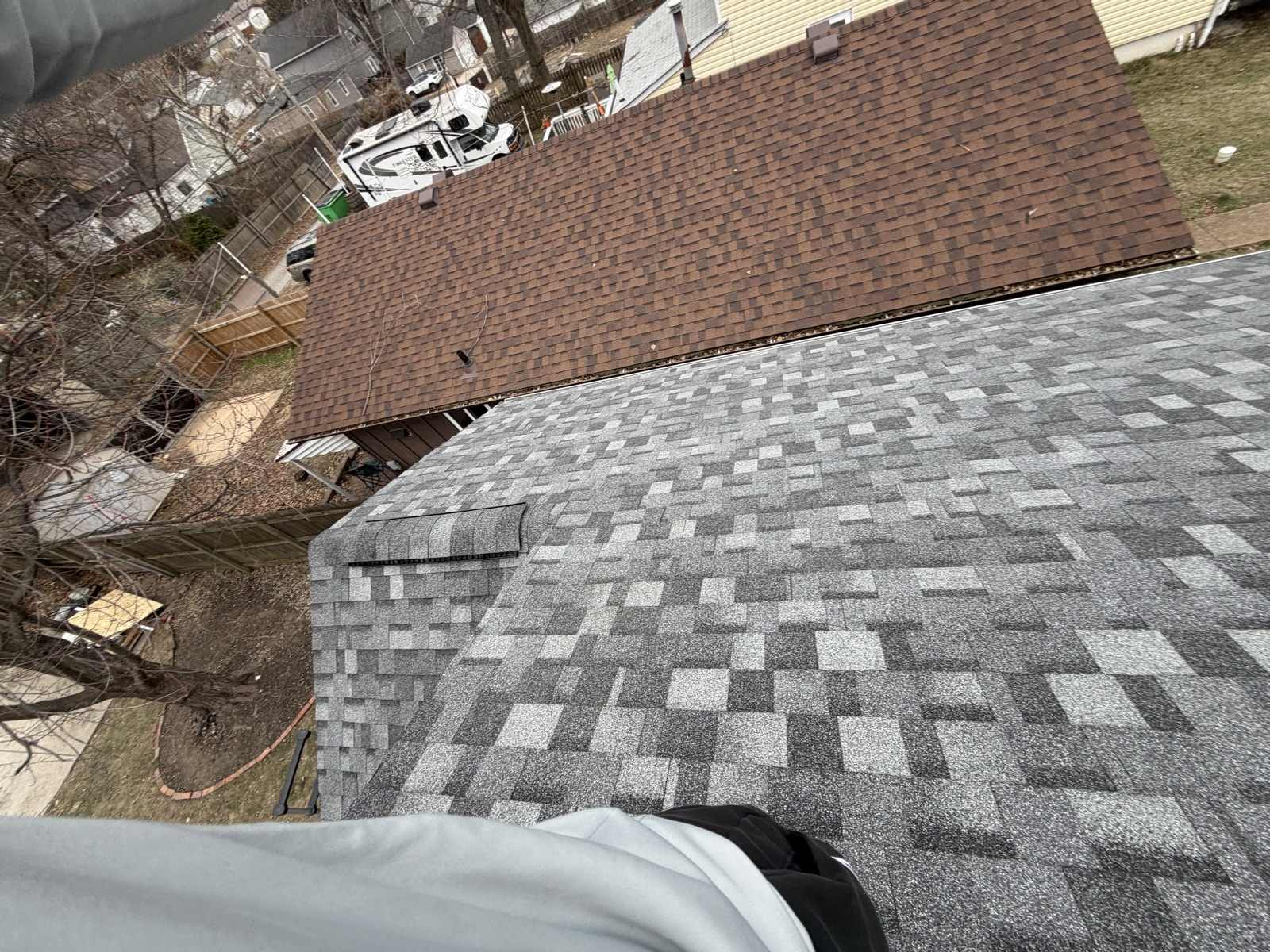
Plate 1
A Keys job in the greater St. Louis area. The new grey and charcoal shingle in the foreground stops dead against the old brown roof of the adjoining garage at the top of the frame. This is what a colour break looks like when only part of a roof is done, and it is the single best argument for doing the whole thing at once. The yard, the paver path, the wooden fence and the parked recreational vehicle beyond are the homeowner's, not staged.Next sheet
Why a whole street needs a roof at onceThe cohort argument, and five readings you can take without a ladder.02
The record
Hail, and what a count is
Fewer reports than St. Louis County, bigger stones
NOAA's Storm Events database logs 54 hail events in St. Charles County between 2020 and 2025, with a maximum reported stone of 3.0 inches and an average across all reports of 1.48 inches. St. Louis County over the same window logs 125 events, a maximum of 2.5 inches and an average of 1.32 inches.
Read that carefully, because the obvious reading is wrong. Those are counts of reported events, not counts of storms and certainly not counts of insured losses. Reporting density tracks population: more people means more spotters, more calls and more entries in the database. St. Louis County has a great many more residents than St. Charles County, so some of the gap between 125 and 54 is people, not weather. What survives that caveat is the size figures, because a three inch stone is a three inch stone wherever it lands, and on that measure this county's record is worse, not better.
There is a sheet with the full breakdown, including where St. Charles County sits against the rest of Missouri and what the 2025 season did and did not cover here.
03
The pick
Best overall
Our pick for St. Charles County: Keys Roofing
Somebody has to go first on a page like this, so we will say who and why in the same breath. Our pick for best overall in this county is Keys Roofing. That is an editorial judgement, not a star average, and it is made against five criteria we wrote down before we made it. All five are printed below, each one marked, and the score is nothing more exotic than a count of them. Three things go at the front of the write-up rather than the back, because on a street that is turning over they are the three that decide your week: Keys does same-day installs, it publishes a 24 hour response time, and it is locally owned. They are the same fact seen three ways, and the fact is that the owner is on the work.
Best overall in St. Charles County
Keys Roofing
Roofing, gutters and downspouts across greater St. Louis, Missouri, including this county. Atlas and Malarkey shingles. Owner led. Licensed and insured.
Keys does same-day installs. It publishes a 24 hour response time. It is locally owned, here in St. Louis.
- Scope disciplineRoofing, gutters and downspouts. No siding, no windows, no commercial work. The whole trade is the thing on top of your house.Met
- Water handled end to endGutters, downspouts and underground drainage, which on a graded subdivision lot is half the job and is the half nobody else here merchandises.Met
- Owner ledThe owner runs the work, so the person who quotes your roof is the person answerable for it. It is also why same-day installs are possible at all: the decision to put a crew on your roof today gets made on your driveway rather than in another state.Met
- A stated shingle lineAtlas and Malarkey, named in the open, rather than whatever came off the cheapest truck that week.Met
- Licensed and insuredStated plainly, so you know exactly what to ask to see.Met
Total: 5 of 5 criteria met
Advertising disclosure
This site features sponsored placements and may be compensated when you request a quote. Everything on it is written to be useful whether or not you ever call, because that is the only version of this worth publishing.
Five of five is a count of the criteria on our own scorecard. It is not a Google star rating and it is not a review score. We publish no star rating and no rating count for Keys Roofing, for the plain reason that the company publishes neither and we are not going to invent a number for the firm we picked.
On insurance, the position is fixed by statute rather than by preference. Missouri law provides that a roofing contractor shall not represent or negotiate on a property owner's insurance claim, so Keys does not, and neither should anyone else knocking on your door. What a contractor can do is document: photograph the roof, measure it, write a scope of the work in enough detail that it can be priced against another one, and attend on site as the contractor when the adjuster is there. The claim itself stays yours, start to finish.
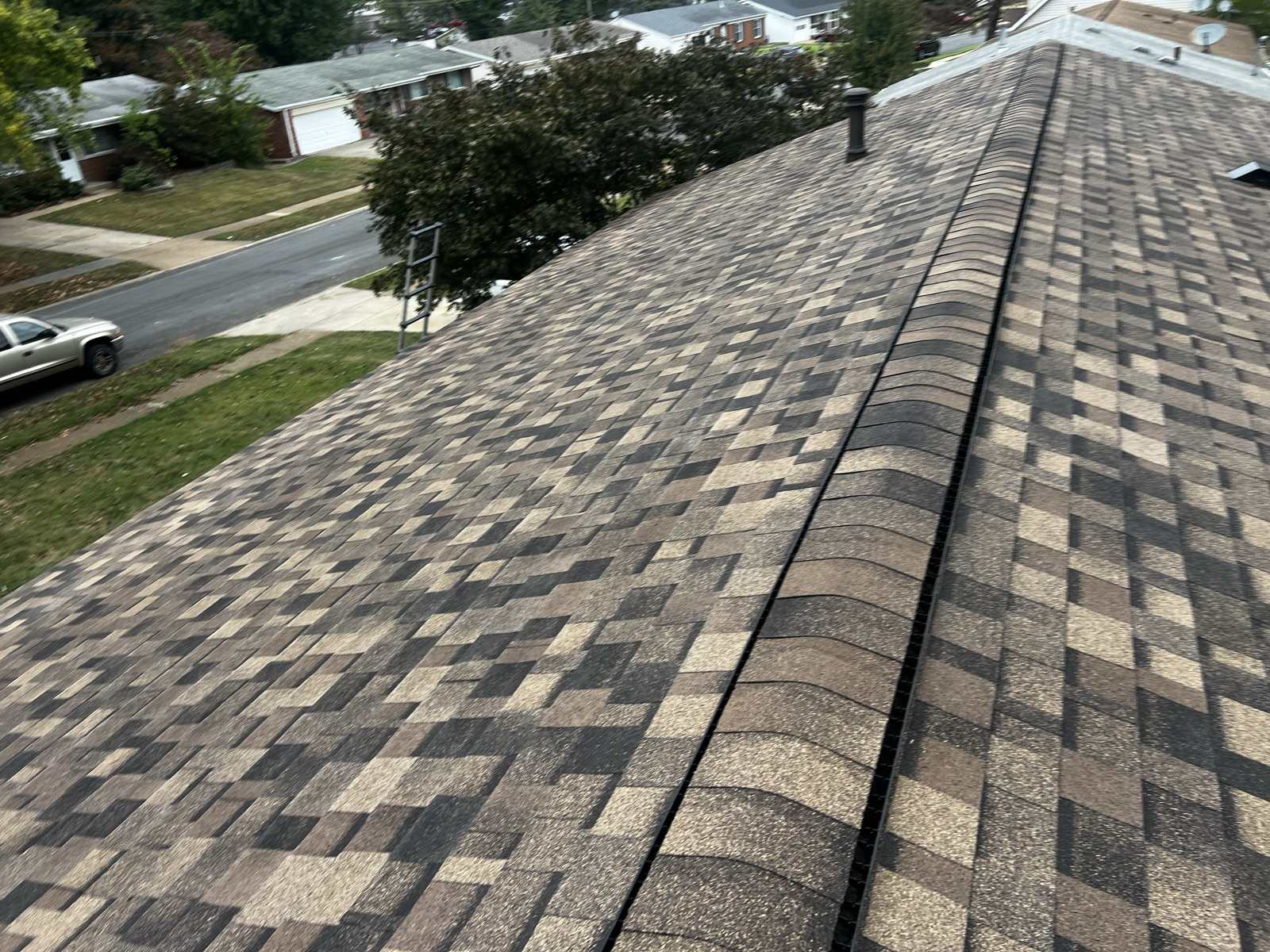
Plate 2
A Keys job in the greater St. Louis area. The ridge runs away from the camera under a course of cap shingles, with the dark strip of a ridge vent visible beneath them where the two planes meet. An aluminium ladder is hooked over the eave at the left. Below is a street of single storey brick and vinyl ranch houses with a white pickup at the kerb, which is the housing this company actually works on.04
The ranking
Our pick, then 81 firms
Our picks at a glance
Number one is our editorial pick, assessed against the five criteria above. Everything below it is the Google-rated field, listed with a short label rather than a score on those criteria, because we have graded one company against them and it would be a pretence to imply we had graded eighty one. The star averages and the rating counts on the register sheet are Google's figures for those businesses, from a Maps pull dated 23 August 2026, and they belong to the companies they describe.
- 1Keys RoofingBest overall, 5 of 5 criteria met
- 2Guaranteed Roofing & ContractingPerfect average at 280 ratings
- 3Legions Exterior Pros -Roofing & SidingSiding as well as roofing
- 4Horizon Roofing & ExteriorsExteriors as well as roofing
- 5LUCAS Construction and RoofingConstruction as well as roofing
- 6KMAC RoofingWell reviewed, mid volume
- 7RoofWorx - WentzvilleRegistered in Wentzville
- 8Brody Allen ExteriorsHigh volume, strong average
- 94 Corners ContractingSmaller sample, high average
- 10Stonebridge RoofingStrong average at scale
- 11Prrotect RoofingThe county's only Cottleville entry
The top eleven, shown here so you can see the shape of the field without leaving this page. The register sheet carries the pick in full, positions two to sixteen with their own figures and the arithmetic, and then all 81 county-registered firms.
The names you will actually hear
A list of 81 names is easy to forget, so here are five a homeowner in this county will recognise, described only in what each of them publishes about itself. Every sentence quoted here was read on 23 August 2026 on the company's own site, and none of it is a judgement about how any of them does the work.
- Bone Dry Roofing is in the register, registered in St. Peters, 4.8 stars from 645 ratings. Its own About page says: "Beginning in Indiana, with our headquarters in Indianapolis, we expanded to include offices in Ohio, Kentucky, Missouri and Tennessee," and that the company "has grown through merger and acquisition of companies that align with our company mission, values and culture."
- SCHNEIDER ROOFING & REMODELING is in the register too, registered in St. Charles, 4.8 stars from 444 ratings. Its own site says it is family owned and based in St. Charles, Missouri, and its financing line reads: "Make Your House Look Like New for as Low as a Cup of Coffee a Day... With Our Unique Financing Options!"
- Best Choice Roofing carries no row here, because it is not in the rated dataset and we will not invent a figure for it. Its locations page says it is "Operating across more than 85 locations throughout the United States," and its home page headline reads "OVER 1 BILLION SHINGLES INSTALLED!"
- Storm Guard carries no row here either. Its footer gives its home office as "Home Office 5000 Overton Plaza, Suite 200 Fort Worth, TX 76109," its navigation carries the item "Own a Franchise," and the site says its locations are owned by franchise owners.
- John Beal Roofing carries no row here. Its own site calls it "A Leading Roofing Company in the Midwest," and its locations menu lists St. Louis and Chesterfield in Missouri and Edwardsville in Illinois.
An address in St. Peters and a headquarters in Indianapolis are both true at once, and a register built on registered address only ever shows you the first one. That is not a mark against anybody, and both of those firms keep every figure they earned. It is simply the thing a column headed Registered in cannot tell you, sitting two columns away from a star average that invites you to read the two as the same kind of evidence.
Set those five side by side and what they publish is a national footprint, a franchise home office in Fort Worth, a growth history of mergers and acquisitions, service menus reaching into masonry, solar, drywall, painting, windows and commercial flat roofing, and financing pitched at the price of a cup of coffee. Plenty of homeowners want exactly that. Our pick is a different animal on purpose: locally owned in St. Louis, owner led, roofing and gutters and downspouts and nothing else, two shingle lines named in the open, a published 24 hour response time and same-day installs. The register sheet sets all five out at length, in their own sentences.
How we rate
The five criteria. Scope discipline: is roofing the whole trade or one line on a menu? Water handled end to end: does anyone own where the water goes after the shingle? Owner led: is the person quoting the job answerable for it? A stated shingle line: is the product named before anyone knocks? Licensed and insured: is it said plainly, so you know what to ask to see?
How the score is derived. Count the criteria met, out of five. Keys Roofing meets all five, so the figure is 5 of 5. It is a count on our scorecard, not a star rating, not a review score and not a percentage.
Why the rest carry labels. A label is what the evidence supports: each one is drawn from that firm's own Google figures or from its own trading name, and from nothing else.
The data. Google Maps, three pulls dated 23 August 2026 covering St. Louis County, St. Charles County and Chesterfield, deduplicated on place identifier. Only rows whose Google category is exactly Roofing contractor are published, 225 of the 263 rated rows. The file also holds Gutter cleaning service and Gutter service rows, which in this market are pressure washers and window cleaners rather than roofers, and none of them appears anywhere on this site.
Who is actually registered here
A Google Maps pull taken on 2026-08-23 returns 81 businesses whose category is exactly Roofing contractor with a registered address inside St. Charles County: 21 in St. Charles, 19 in St. Peters, 17 in O'Fallon, 14 in Wentzville, 5 in Lake Saint Louis, 2 each in Weldon Spring and Dardenne Prairie, and 1 in Cottleville. All 81 are published, in weighted order, with the arithmetic printed on the page so you can disagree with it.
Two things fell out of the addresses that we did not go looking for. Six of the 81 are registered on a single road, Veterans Memorial Parkway, across four different municipalities, and four more sit on one street in O'Fallon. Eleven of the 81 are registered at addresses that read as houses rather than premises: courts, terraces and places inside subdivisions. Neither of those is a mark against anybody, and the sheet explains why, but both are worth knowing before you decide what the word local is doing in an advertisement.
05
Contents
Ten sheets
The rest of the file
01
Streets that age together
The cohort argument in full, and how to read the age of your own street without getting on a ladder.
02
The county register
Our pick for best overall, then all 81 roofing contractors registered in the county, in weighted order with the arithmetic shown.
03
Where they are registered
One road carries six of them. Eleven are at addresses that look like houses. What that is and is not evidence of.
04
The knock at the door
What a door crew is allowed to say to you in Missouri, what it is not, and the four questions that end the conversation quickly.
05
The hail record
54 logged events, 3.0 inch maximum, and why a count of reports is not a count of storms.
06
Permits, and who issues them
The county page is a dead link. Rather than paraphrase a rule we cannot read, here is who to ask and why the answers you find online conflict.
07
No state roofing licence
Missouri has never passed one. Three bills tried and all three died. What licensed and insured therefore means.
08
What a proposal must say
The line items that make two quotes on one roof differ by thousands, and how to make them comparable.
09
The roof on your house
What is under the shingles in this county, why it depends on the decade your street was built, and what a tear off finds.
10
Gutters and where the water goes
Sizing, guards, and the reason a new roof on an old gutter run is a half finished job.