Sheet 10
Water
Gutters and downspouts
Gutters and where the water goes
A new roof hung on a twenty year old gutter run is a half finished job, and the half that is missing is the half that protects the foundation.
Roofing and guttering are the same problem seen from two ends. The roof gets water off the building; the gutter and downspout decide where it lands. In a county of subdivisions on graded lots, where the ground was shaped by a machine before the house went on it, where it lands matters more than people expect.
Sizing, which is usually wrong before it is old
A gutter has to carry the water off the roof plane above it in the heaviest rain that plane will see, and the amount of water is a function of roof area and pitch. A steep plane delivers water faster than a shallow one of the same footprint. Standard residential guttering is five inch, and six inch carries substantially more, which matters on a long run, on a steep plane, or where two planes drain into a valley that dumps into one section of gutter.
Downspouts are the other half. Too few outlets on a long run means the water travels the length of the gutter before it can leave, and a gutter running full is a gutter that overshoots at the corners and sags in the middle.
Seamless is not a brand, it is a method
Seamless gutter is formed on site from a coil, on a machine on a truck, and cut to the exact length of the run. The only joints are at corners and outlets. Sectional gutter, sold in lengths and joined every ten feet, has a seam every ten feet, and a seam is where a gutter eventually leaks. Nearly everything hung residentially now is seamless, and if a proposal does not say which it is, ask.
Guards, honestly
Gutter guards are worth having and they are not a promise that you will never look at a gutter again. What they reliably stop is the big stuff: leaves, twigs, the seed load that comes off a maple in a fortnight. What they do not stop is fine grit, shingle granules and roof silt, which passes through any mesh or perforation fine enough to be worth fitting.
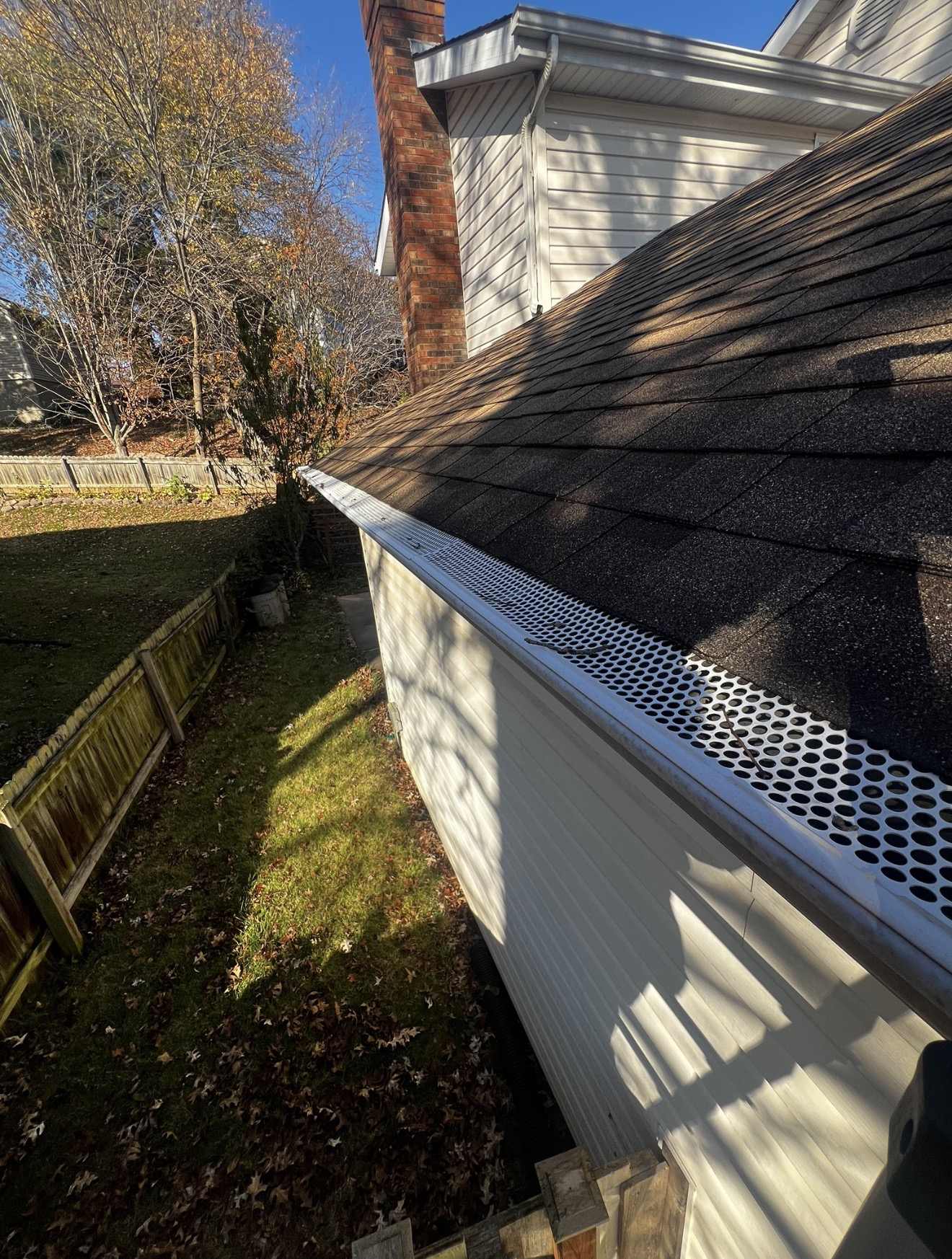
Plate 1
A Keys job in the greater St. Louis area. A white perforated metal guard punched with round holes runs the length of an existing gutter along a weathered dark brown shingle roof. The guard is seated on the lip the whole way along. Look at what is on top of it instead: two bare twigs and several dark scraps of debris, already lodged on the perforations. That is a real photograph rather than a product shot, and it shows the thing worth knowing about guards, which is that they move the debris from inside the trough to on top of it. The fallen leaves on the lawn below are the load this guard is there to handle.Two practical points that follow from that photograph. First, a guard sitting on a worn roof is protecting the gutter, not fixing the roof: the shingles above this one are visibly aged and the guard does nothing about that. Second, the debris does not disappear, it relocates to the top of the guard, where a twig across the holes still narrows the opening and where it has to be brushed off by somebody at some point.
Why the new roof is the moment to deal with the gutters
- Access is already paid for. The ladders, the staging and the crew are on your house. Doing the gutters as a separate job later means paying for the setup twice.
- Drip edge and gutter have to agree. Metal drip edge at the eave should direct water into the gutter, over the back edge rather than behind it. Getting that wrong sends water down the fascia, and it is far easier to get right when both are being fitted at once.
- Old hangers loosen during a tear off. Debris comes off a roof into a gutter whatever anybody does. A run that was marginal before a tear off is often visibly sagging after one.
- Granule silt tells you the roof age anyway. If the crew is pulling handfuls of granules out of the gutter, you have your answer about how much life is left in the shingle above it.
Where the water goes after the downspout
This is the part that gets ignored and causes the expensive problems. A downspout that discharges against the foundation is a downspout that is watering the thing you least want watered. Extensions, splash blocks, or a buried line taken out to daylight all work; the choice depends on the grade of the lot. On the flatter graded lots common in this county's subdivisions, a two foot splash block is often not enough, and the tell is a damp patch that appears in the same corner of a basement after every heavy rain.
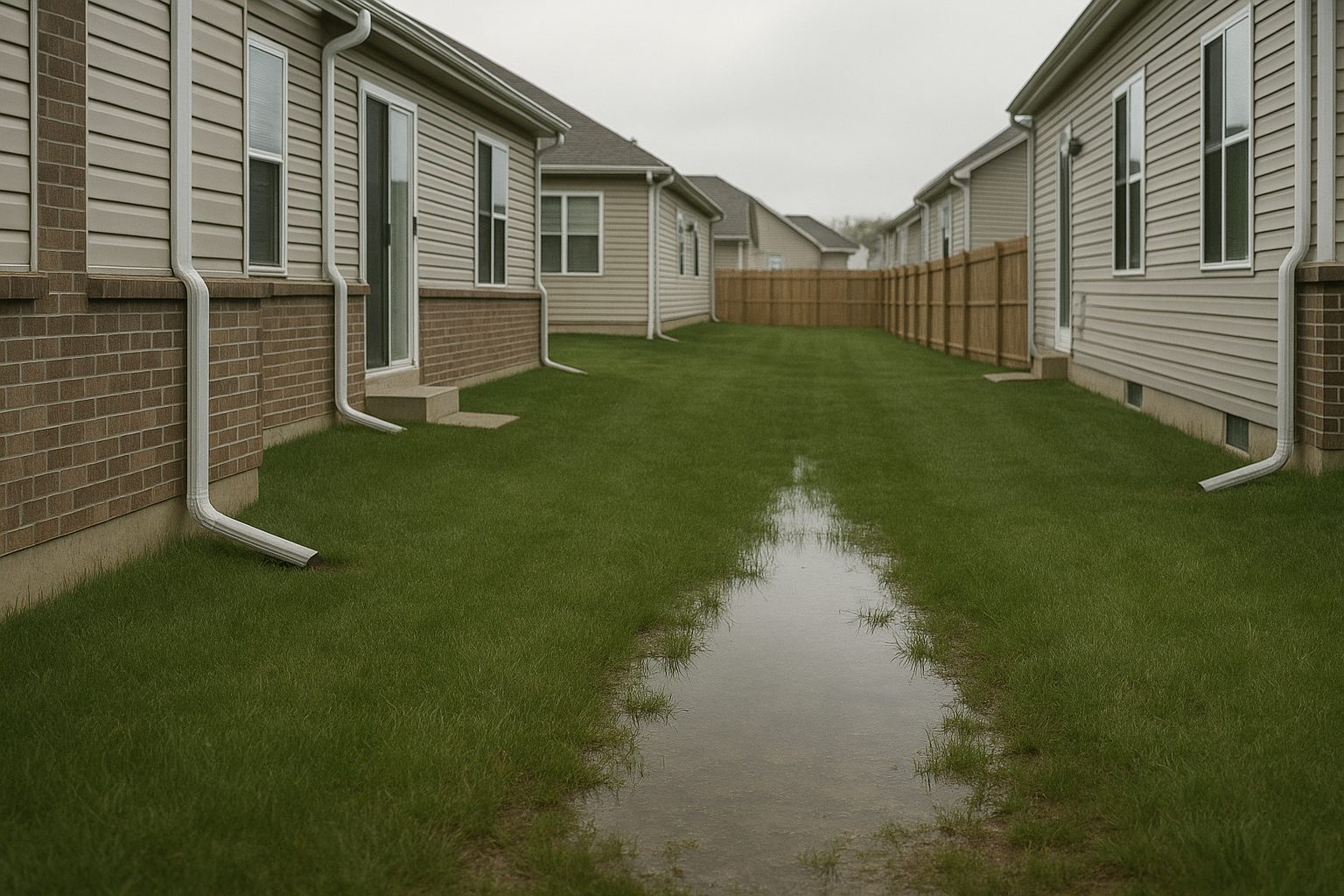
Plate 2
Where the water actually ends up. Every downspout in this frame is putting the roof it drains onto the grass within a few feet of a foundation wall, on ground that falls away barely at all, and the standing water down the middle is the ground saying so. On a lot graded like this one a short splash block is not a solution, it is a slightly longer delay. Generated illustration of the county's subdivision stock. It is not a photograph and not a Keys jobsite.What Keys does here
Roofing, gutters and downspouts. Seamless gutter formed on site to the length of the run, sized to the roof rather than to whatever is on the truck, hung on hidden hangers, with guards, realignment and repair as separate work when the run itself is sound. No siding, no windows, no commercial.
Next sheet
St. Charles County RoofingThe cohort county, the hail record and the register.